


Sawbones at 50: A Legacy of Confidence Through Practice
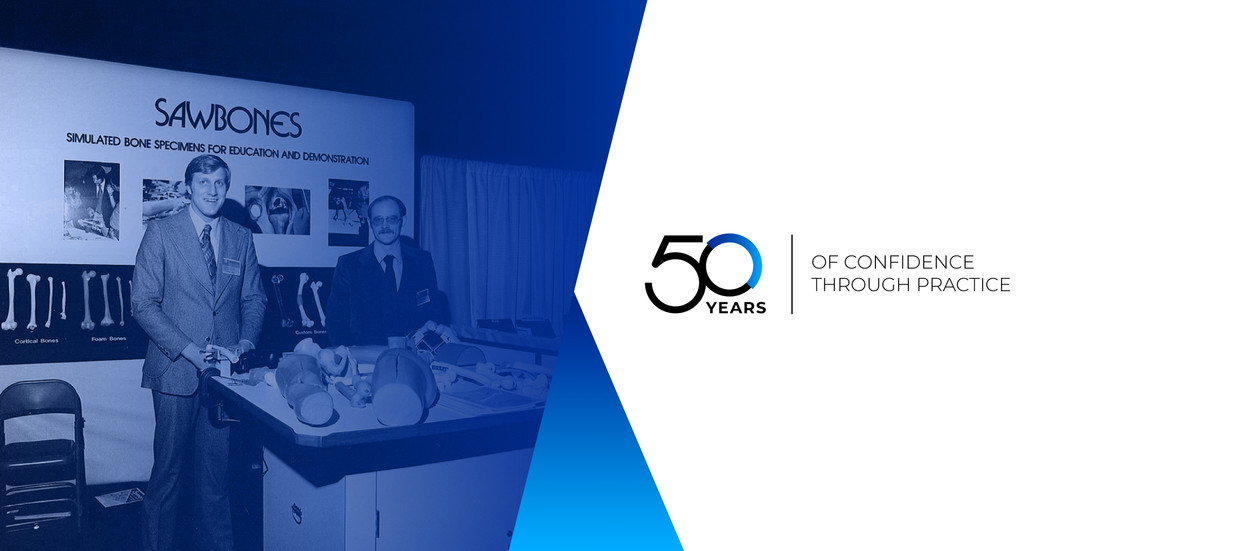
This year Sawbones turns 50!
Fifty years is a long time to earn trust—and an even longer time to keep it.
In 2026, Sawbones reaches a milestone we’re proud of not simply because it marks a date on a calendar, but because it represents something deeper: 50 years of confidence through practice. Confidence for the student who’s picking up an instrument for the first time. Confidence for the clinician refining a technique for the hundredth time. Confidence for the educator who needs learners to make mistakes here—so they can avoid them out there.
This anniversary is a celebration of how far medical training has come, and a recognition of the people who have pushed it forward: instructors, learners, innovators, and healthcare teams who believe skill is built the right way—through repetition, feedback, and hands-on practice.
Where it began: building better practice
A pivotal collaboration with Dr. Frederick Lippert shaped the first Sawbones models and set a standard we still prioritize: anatomical realism paired with reliable performance. Together, we focused on creating training models that better represented anatomy and the tactile experience of working with bone so that learners could build both skill and confidence before stepping into the OR.
That consistency matters for education, where instructors need repeatable outcomes, and it matters just as much for research, where repeatability supports meaningful comparison.
The rise of the “Sawbones Lab”
In orthopaedics, you’ll often hear people refer to a hands-on skills session as a “Sawbones Lab”—sometimes even when the models in the room aren’t ours. That association didn’t happen by accident. It came about because Sawbones set the industry standard for anatomical simulation in orthopaedic training and became the most recognized and trusted name associated with it.
We don’t take that lightly. To us, it’s a reminder that when people say “Sawbones Lab,” they’re really talking about a level of expectation: realistic anatomy, consistent performance, and training tools that hold up to repeated use.
It’s a sign that what we created decades ago has become a core part of how skills are taught and maintained.
Innovation that follows the learner
In the last 50 years, medical education has evolved dramatically. Procedures have become more specialized. Technology has accelerated. Expectations for readiness have increased. And training has expanded far beyond one room, one specialty, or one moment in a career.
Sawbones has evolved, too—continually building new models and systems designed around how people actually learn.
From foundational anatomy to advanced technique
Orthopedics has always been at our core, from fracture management to joint procedures. But as the world of surgery changed, training needed to change with it.
Arthroscopy is a perfect example. As minimally invasive techniques became more common, the demand grew for models that could replicate joint access, spatial challenges, and the coordination required to operate with indirect visualization. That shift wasn’t just about new procedures—it was about a new way of thinking, seeing, and learning.
Expanding across healthcare specialties
We’ve grown alongside the expanding needs of healthcare education. Training is no longer limited to one stage or one discipline. Today, we support learning and simulation across many areas—including physical therapy, ultrasound education and nursing skills training, where tactile experience, repetition, and muscle memory matter just as much as they do in the OR.
50 years in, still focused on the work
As we look ahead, one thing is certain: simulation will continue to play a big role in medical education. Training needs will keep expanding—across specialties, across roles, across settings.
Our commitment for the future will remain the same: build tools that make a difference.
Ready to build your next lab, training program, or validation setup?
Reach out to our team to explore our simulation solutions.
Recent Posts
-

Sawbones at 50: A Legacy of Confidence Through Practice
This year Sawbones turns 50! Fifty years is a long time to earn trust—and an even longer time to kee
-

Thank You for a Great Year — Holiday Closure Notice
As the year winds down, all of us at Sawbones want to say a sincere thank you for your partnership a